I may earn a commission at no extra cost to you. #ad
Free Guide: Bugging Out vs. Hunkering Down - The Decision-Making Manual
Jump to Section
Understanding the Fundamental Dilemma
In the world of emergency preparedness, few debates are as spirited as the choice between bugging out and hunkering down (also known as bugging in). The romanticized image of the survivalist involves grabbing a pack and heading for the hills, but reality is often much more complex.
The decision to stay or go is not one you should make in the heat of a crisis. Instead, it requires a pre-calculated framework based on the nature of the threat, your resources, and your physical environment. This manual is designed to help you build that framework, ensuring that when the time comes, you can act with clarity and confidence.
When Hunkering Down is the Superior Choice
For most scenarios, hunkering down is the default survival strategy—and for good reason. Your home is where your life is established. It contains your heavy-duty supplies, your medical equipment, and your most comfortable shelter.
The Advantages of Bugging In:
- Resources: It is nearly impossible to transport six months of food and water in a vehicle, let alone on your back. Staying home keeps you connected to your full inventory.
- Security: You know every corner of your property. You have presumably reinforced your doors, installed cameras, and established a defensive perimeter that you understand better than any forest trail.
- Health: If you have family members who are elderly, very young, or have medical conditions, staying put is almost always safer than the physical rigors of evacuation.
- Anonymity: If you stay inside and maintain a "low-profile" (light and noise discipline), you may remain unnoticed by those who are desperate or opportunistic.
The Red Lines: When You Must Bug Out
Despite the advantages of staying home, there are "red lines" that, once crossed, make bugging out the only viable option. Ignoring these triggers out of a sense of stubbornness can be fatal.
Critical Triggers for Evacuation:
- Environmental Hazard: Wildfires, rising floodwaters, or a chemical spill in your immediate vicinity. You cannot defend against a forest fire with a rifle.
- Structural Damage: If an earthquake or storm has rendered your home unsafe or open to the elements, staying is no longer a viable option.
- Security Breach: If your neighborhood has become a war zone and your home can no longer be defended against the volume of threats, it is time to move to a secondary location.
- Resource Depletion: If you run out of water and your local sources are contaminated or dry, you must move to where the resources are.
Evaluating Your Location and Environment
Your geographical location dictates your strategy more than any other factor. An urban dweller has a much different decision-making process than someone living in a rural area.
Urban and Suburban Environments: These areas are high-density and resource-dependent. If the supply chain breaks and the power goes out, cities can become dangerous quickly. Urbanites must have a well-rehearsed bug-out plan because their "hunker down" window is often much shorter.
Rural Environments: Those in rural areas often have the luxury of bugging in for much longer periods. With land for gardening, access to well water, and lower population density, the threshold for bugging out is significantly higher.
The Logistics of Transitioning: In to Out
One of the biggest mistakes preppers make is viewing these two options as mutually exclusive. In reality, you should be prepared to transition from hunkering down to bugging out at a moment's notice.
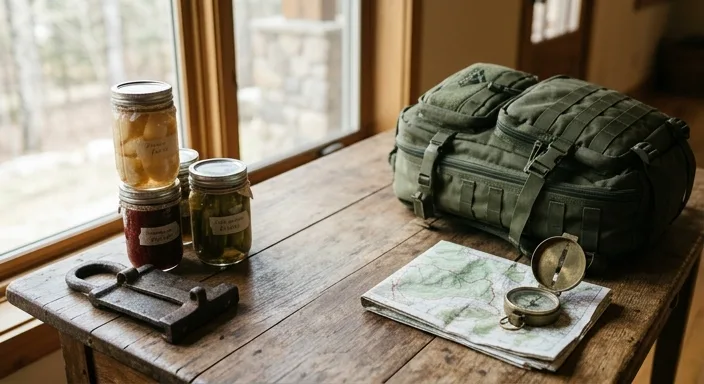
This means keeping your Bug Out Bag (BOB) staged and ready even while you are "bugged in." It means ensuring your vehicle is always at least half-full of fuel and that your "Get Out Of Town" (GOOT) maps are marked with multiple routes that avoid major highways, which will likely be gridlocked.
The Survivalist’s Decision Checklist
When the sirens go off, use this quick checklist to evaluate your situation:
- Is the threat immediate and physical (fire, water, gas)? If yes, Bug Out.
- Is my home's structure compromised? If yes, Bug Out.
- Do I have 72 hours of water and food available? If no, Bug Out (while you still have fuel).
- Can I defend this location against likely threats? If no, Bug Out.
- Is the situation likely to resolve within 14 days? If yes, Hunker Down.
Remember: "Too early is better than too late." If you wait until you are forced to leave, you will be competing with thousands of others for the same road space and resources.
Frequently Asked Questions
Q: Should I go to the woods if I bug out?
A: Only if you have a specific, prepared location. "Heading to the hills" without a destination is just being homeless in the woods. Always have a Bug Out Location (BOL).
Q: What if my family disagrees on staying or going?
A: This is why you need a plan now. Establish "trigger points" that everyone agrees on beforehand so the decision is data-driven, not emotional.
Q: Is a vehicle always the best way to bug out?
A: It's the most efficient for carrying gear, but you must have a backup (bikes or foot) in case of road closures or EMP scenarios.