I may earn a commission at no extra cost to you. #ad
Free Guide: How to Build a 3-Month Emergency Food Supply on a Budget
Jump to Section
The Importance of a 3-Month Food Supply
In an increasingly uncertain world, the concept of a "prepper pantry" has moved from the fringes to the mainstream. Whether it’s a localized natural disaster, a supply chain disruption, or unexpected financial hardship, having a three-month food supply provides a vital safety net. Unlike a short-term 72-hour kit, a 90-day supply allows you to weather longer-term crises without relying on empty grocery store shelves.
Many people are intimidated by the cost of long-term storage, but building this reserve doesn't require a massive upfront investment. By focusing on shelf-stable, calorie-dense basics and using a strategic purchasing plan, you can build a robust supply for the price of a few lattes a week.
Calculating Your Nutritional Needs
Before you buy your first bag of rice, you need to know how much food your family actually requires. A common mistake is focusing solely on volume rather than calories and nutrition. In a high-stress emergency scenario, your caloric needs may actually increase.
Aim for an average of 2,000 to 2,500 calories per adult, per day. For a 90-day supply for one person, that is roughly 180,000 to 225,000 calories. Don't forget to account for macronutrients: proteins for muscle maintenance, fats for long-term energy and brain health, and carbohydrates for immediate fuel. If you have children, elderly family members, or pets, adjust these totals accordingly.
Affordable Staples: The Foundation
To keep costs low, your 3-month supply should be built around "the big four" staples: grains, legumes, fats, and sweeteners. These items provide the highest caloric "bang for your buck."
- White Rice: Extremely cheap and lasts 25+ years if stored correctly.
- Dried Beans: Lentils, pinto beans, and black beans provide essential protein and fiber.
- Oats: A versatile breakfast staple that is easy to prepare.
- Pasta: High in carbohydrates and very inexpensive during sales.
- Canned Goods: Vegetables, fruits, and meats (like tuna or chicken) provide variety and necessary vitamins.
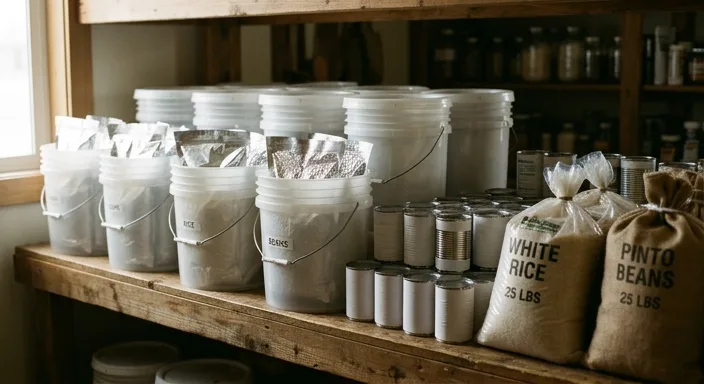
Focusing on these basics allows you to spend as little as $1.00 to $2.00 per day per person. While eating rice and beans every day isn't ideal, it ensures survival during a total collapse of food access.
The "Store What You Eat" Strategy
One of the biggest wastes of money in prepping is buying "survival food kits" that your family hates. If you don't eat freeze-dried broccoli normally, don't buy 50 pounds of it now. Instead, practice the Copy-Canning method.
Every time you buy a non-perishable item you enjoy—like a jar of peanut butter or a box of pasta—buy two. This slowly builds your surplus without a shocking bill at the register. Over time, your pantry will be filled with food you actually know how to cook and your family enjoys eating, which is a massive morale booster during a crisis.
Smart Buying and Inventory Management
To stay on budget, you must become a savvy shopper. Avoid "prepper" branded websites for your basics; stick to warehouse clubs (Costco, Sam's Club) or ethnic grocery stores. Large bags of rice and spices are often significantly cheaper at Asian or Mexican markets.
Use a simple "First-In, First-Out" (FIFO) system. Place the newest items at the back of the shelf and pull from the front. This ensures your food stays fresh and you aren't throwing away expired cans. Keep a simple spreadsheet or a notebook tracking what you have and the expiration dates.
Proper Storage to Protect Your Investment
Heat, light, moisture, and pests are the enemies of food storage. To make your budget supply last for years, follow these rules:
- Temperature: Store food in a cool, dry place. A basement or an interior closet is better than a garage or attic.
- Containers: For bulk grains and beans, use Mylar bags with oxygen absorbers inside 5-gallon plastic buckets. This creates an airtight, pest-proof environment.
- Organization: Keep food off the floor to prevent moisture damage and to make cleaning easier.
Water: The Critical Component
You can survive weeks without food, but only days without water. For a 3-month supply, you need at least 1 gallon of water per person per day for drinking and basic hygiene. For a 90-day supply, that’s 90 gallons per person. Storing this much can be difficult, so focus on a mix of stored water (like 55-gallon drums or stacked cases) and high-quality filtration methods (like a Berkey filter or Sawyers) to treat secondary sources.
Frequently Asked Questions
How much does it cost to build a 3-month supply?
If you focus on bulk staples like rice and beans, you can build a basic 3-month supply for one person for approximately $150 to $300, depending on your local prices and sales.
Should I buy pre-packaged 25-year survival meals?
While convenient, these are often the most expensive way to prep. They are good for "grab-and-go" situations, but building your own pantry is significantly cheaper and usually more nutritious.
What about vitamins?
A long-term diet of stored staples can be low in certain vitamins (especially Vitamin C). Adding a high-quality multivitamin to your storage is an affordable way to prevent nutritional deficiencies.