I may earn a commission at no extra cost to you. #ad
Master Home Security and Perimeter Defense for Disaster Scenarios
Jump to Section
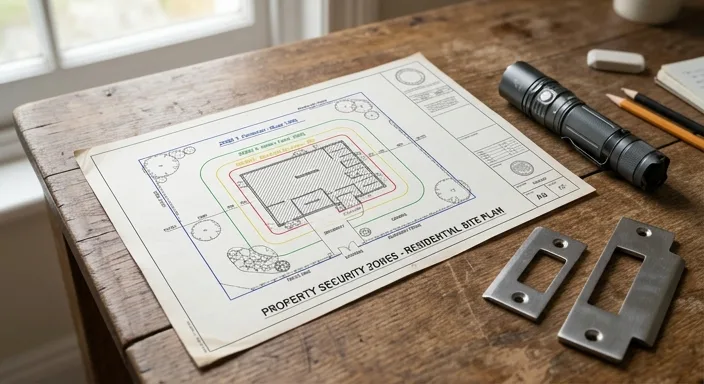
The Principles of Defense-in-Depth
In a disaster scenario, home security isn't about a single lock or a high-tech camera system. It is about Defense-in-Depth—a strategy used by military and high-security installations that utilizes multiple layers of security to delay, deter, and defeat potential threats.
The goal is to create a series of obstacles. If an intruder bypasses the first layer (your property line), they should encounter a second (your yard), then a third (your home’s exterior), and finally a fourth (your safe room). Each layer should provide you with more time to react and convince the intruder that your home is a "hard target" not worth the effort.
Securing the Outer Perimeter
Your first line of defense begins at the very edge of your property. In a grid-down or civil unrest situation, you want to define your space clearly and discourage casual trespassing.
- Fencing and Gates: While a standard wooden fence won't stop a determined attacker, it creates a psychological and physical barrier. Ensure gates are locked with high-quality padlocks.
- Defensive Landscaping: Nature provides excellent security. Planting "thorny" vegetation like Holly, Hawthorn, or Barberry beneath windows and along fence lines makes unauthorized entry painful and noisy.
- Lighting: Visibility is an intruder's worst enemy. Use motion-activated solar lights to eliminate dark corners where someone could hide. In a disaster where power is out, solar-rechargeable units are essential.
- Signage: Signs indicating "Private Property" or "Security Cameras" (even if they are decoys) can act as a deterrent for low-level opportunists.
Hardening the Home Envelope
If an intruder reaches your house, the "envelope" (doors and windows) must be resilient enough to withstand forced entry attempts. Most standard homes can be breached with a single kick; your goal is to change that.
Doors: Replace standard 1-inch screws in your strike plate with 3-inch or 4-inch hardened steel screws. This anchors the door to the wall studs rather than just the flimsy decorative trim. Consider a "Nightlock" or a security bar that braces the door against the floor.
Windows: Windows are the weakest point. Applying security window film can prevent the glass from shattering upon impact, forcing an intruder to spend minutes—rather than seconds—trying to create an opening. Furthermore, ensure all window locks are functional and consider adding secondary locking pins.
Interior Safe Rooms and Final Defenses
If the exterior is breached, you need a designated safe area for your family. A safe room doesn't have to be a concrete bunker; it can be a reinforced bedroom or closet.
This room should have a solid-core door, a heavy-duty deadbolt, and communication equipment (cell phone, two-way radio). Most importantly, it should contain your defensive tools and a first-aid kit. Prepare for the possibility of a "last stand" scenario where you must protect life until the threat retreats or help arrives.
Low-Tech vs. High-Tech Security Solutions
Modern technology offers amazing tools, but in a long-term disaster, high-tech systems may fail without internet or constant power. A balanced approach is best.
High-Tech: Off-grid DVR camera systems powered by solar/battery banks allow you to monitor your perimeter without leaving the safety of your home. Driveway alarms are also excellent for early warning.
Low-Tech: A well-trained dog is perhaps the best alarm system ever invented. Beyond animals, simple "tripwire" alarms (using air horns or battery-operated buzzers) can alert you to movement in the yard. Even gravel paths around the house act as a low-tech "acoustic" alarm because they are impossible to walk on silently.
Maintaining Operational Security (OPSEC)
The best defense is not being a target in the first place. Operational Security (OPSEC) is the practice of keeping your preparations and resources a secret.
During a crisis, do not advertise that you have food, water, or power. If your house is the only one on the block with lights on and the smell of cooking food wafting out the windows, you will attract unwanted attention. Use blackout curtains to hide light and try to minimize noise from generators or tools. "Grey Man" theory applies to your home just as much as your person—make your house look just as miserable and "picked over" as everyone else's from the street.